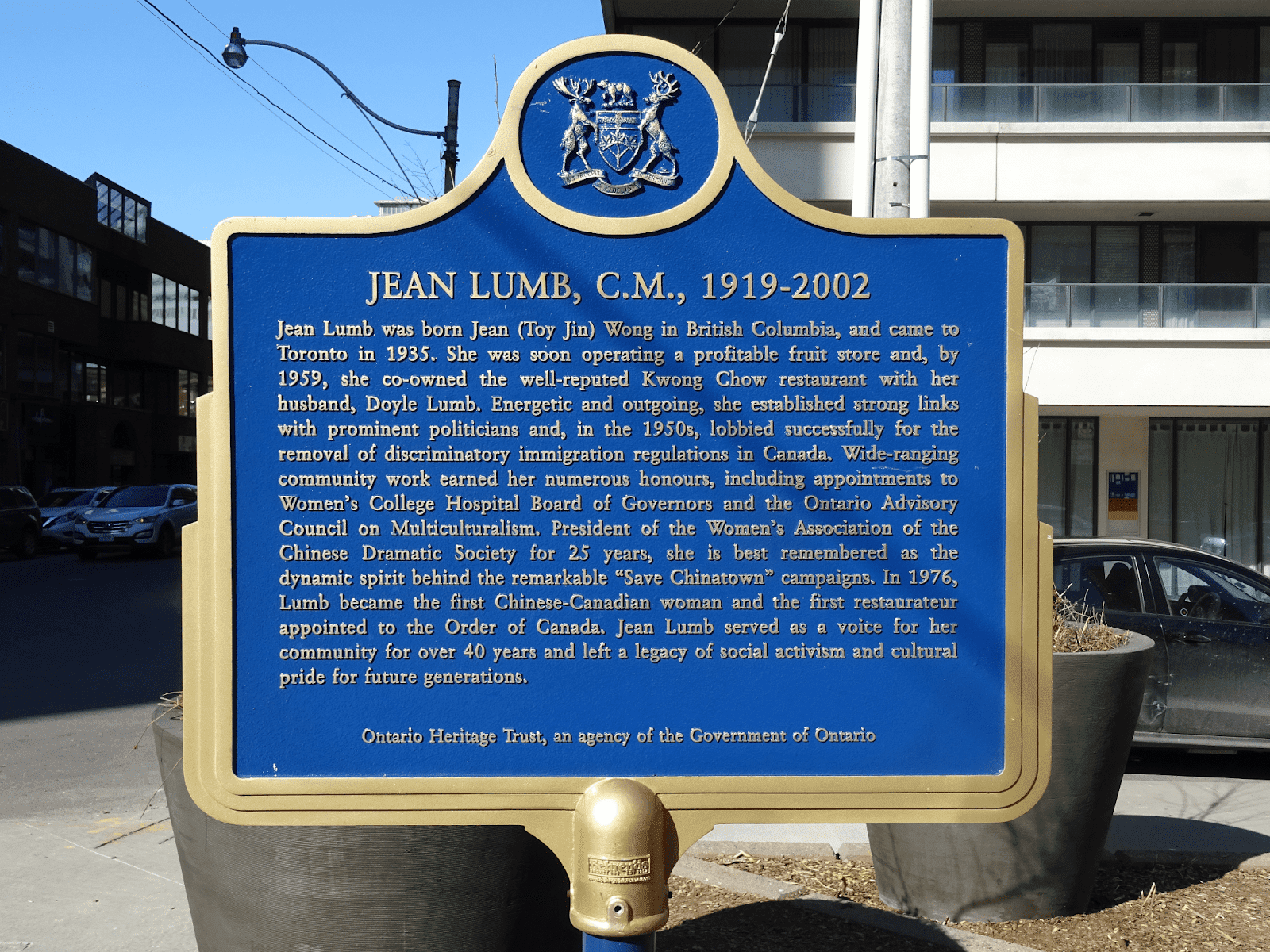

Jean Bessie Lumb was a community leader, restaurateur, and the first Canadian woman of Chinese descent to be appointed to the Order of Canada. She is known for her successful advocacy to end federal government policies that separated Chinese families. Lumb also led the Chinatown Preservation Committee, striving to prevent further destruction of Toronto’s Chinatown. Read more on torontonka.com.
Childhood and Move to Toronto
Jean was born on July 30, 1919, in Nanaimo, British Columbia, the sixth child in her family. Her father, Fan Gee Wong, had arrived from China in 1899 to work as an agricultural laborer, followed by her mother, Hone Hung Ma, who joined him in Canada several years later. Growing up in Nanaimo and then Vancouver came with challenges, as British Columbia at the time enforced over 100 anti-Chinese laws and policies. Though Jean was a diligent student, she had to leave school at age 12 to help support her family during the Great Depression. In 1935, her older sister urged Jean to move to Sudbury, Ontario, where she had been offered a job. Jean was just 16 years old at the time.
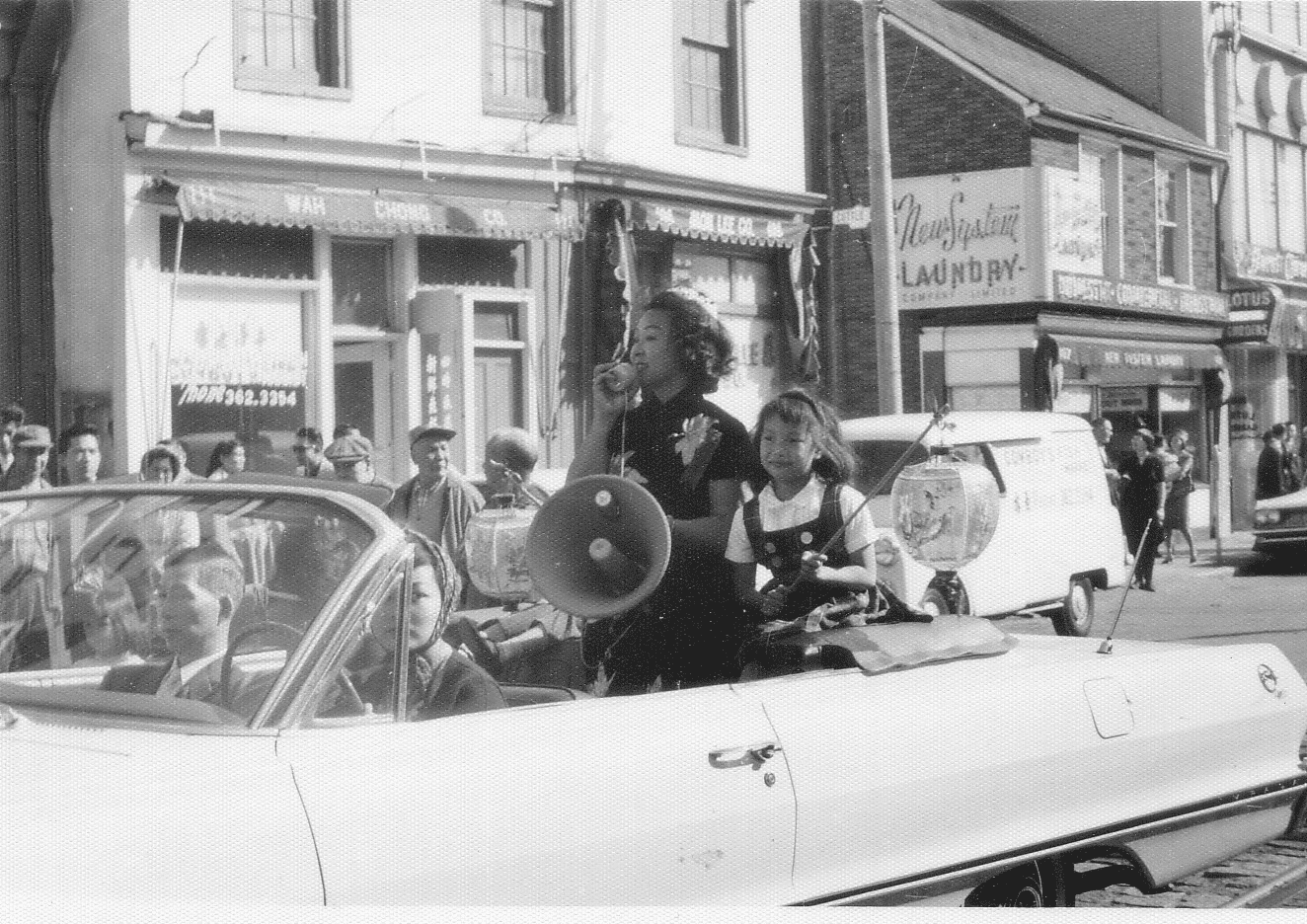
In 1936, Jean Bessie moved to Toronto, where she opened two fruit stores. Her business became successful enough that she could bring her parents and siblings from Vancouver. Following her mother’s advice, Jean married Doyle Lumb in 1939. However, since Doyle was born in China, Jean lost her Canadian citizenship due to laws that determined a woman’s nationality based on her husband’s status. Together, they ran a fruit store in the Junction area and raised six children.
Immigration Reform and Family Reunification
Settling in Toronto, Jean was disheartened to see Chinatown populated mainly by bachelors, with few Chinese women present. With families divided by discriminatory policies, only about ten full Chinese families resided in the community. This, combined with her love for family, inspired Jean to advocate for change.
Lumb gained national recognition for challenging immigration laws that affected her community and family. The Chinese Head Tax, implemented from 1885 to 1923, was Canada’s first race-based immigration legislation. Intended to deter Chinese immigrants, this entry fee required payments of $50, $100, or $500 from her father, mother, and husband, respectively. When the Head Tax proved ineffective in deterring immigration, the government introduced the Chinese Immigration Act of 1923, or the “Chinese Exclusion Act,” which effectively barred Chinese immigrants for 24 years. All Chinese residents, regardless of citizenship, were required to register for identification.
The repeal of this law in 1947 rekindled hope for family reunification, yet restrictions remained. Only Canadian citizens could apply to bring their spouses and unmarried children under 18 to Canada. Driven by the belief that families should be together, Lumb joined a 40-member Canadian-Chinese delegation that lobbied for change. She was the only woman in the delegation that met with Prime Minister John Diefenbaker in 1957.
The Kwong Chow Chop Suey House: A “Reunification Restaurant”
Later, Jean and her husband opened the Kwong Chow Chop Suey House in Toronto’s Chinatown in 1959, which operated for 26 years. The restaurant, popular among both Canadians and Chinese, became a hub for politicians, journalists, celebrities, business leaders, and community figures, all contributing to reshaping perceptions of the Chinese community.
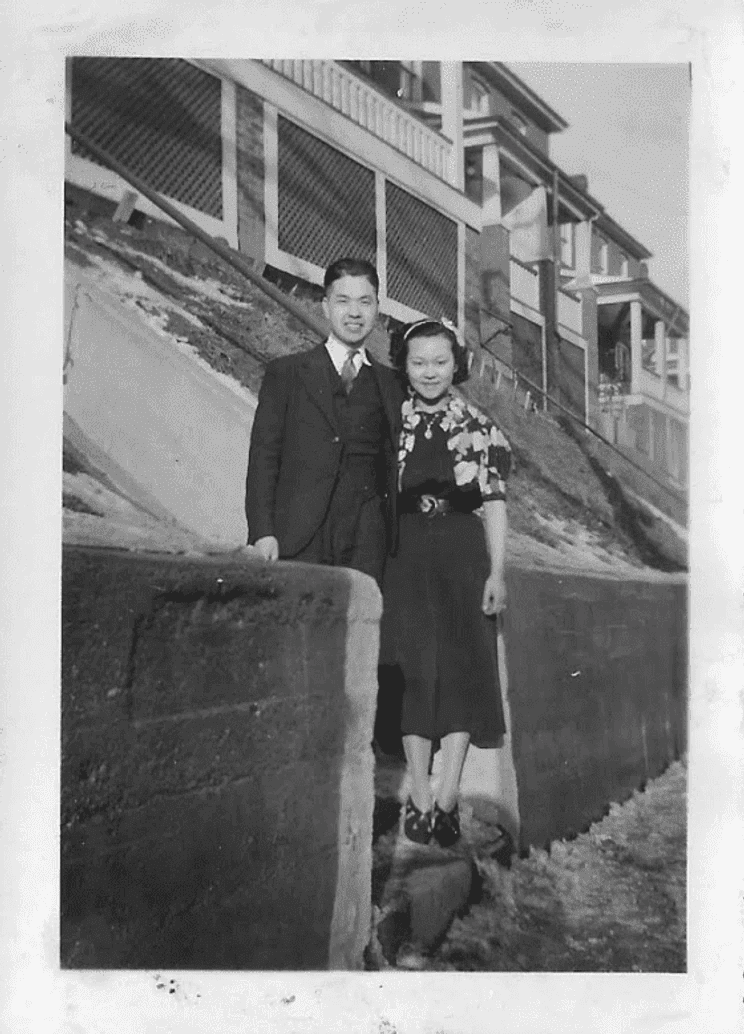
In addition to hosting guests at her restaurant, Lumb introduced Chinese food at establishments such as Eaton’s, Simpsons, and the Royal Ontario Museum, appearing on television and radio to promote her culture. Jean also championed Chinese cultural dance, founding the Ontario Dancers Association in 1959. The troupe performed traditional lion dances and classical Chinese routines at festivals and parades across Canada, even presenting for Queen Elizabeth II during Canada’s centennial in 1967 on Parliament Hill.
The Chinatown Preservation Committee and Lumb’s Activism
Jean’s dedication to preserving and promoting Chinese culture was especially evident through her leadership of the Chinatown Preservation Committee. With two-thirds of Toronto’s original Chinatown demolished for the construction of the new City Hall and Nathan Phillips Square, the city proposed further expropriation. Under Jean’s leadership, the Committee fought to save the remaining Chinatown, preserving a space where the Chinese community could celebrate and share its heritage with Canadians.
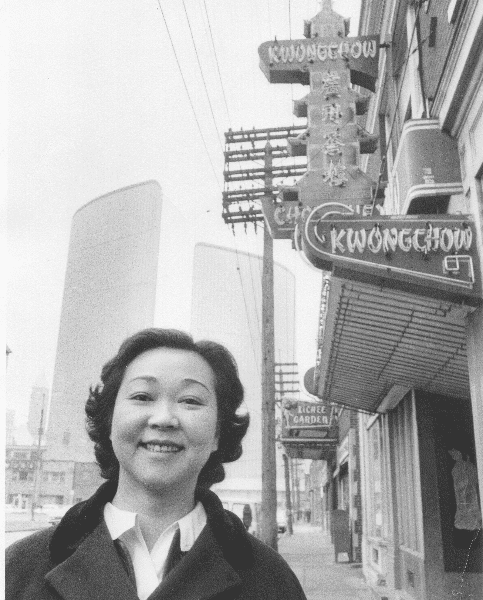
In 1969, the city adopted a plan to preserve Chinatown. Her desire to bridge cultural divides inspired numerous roles: she was a member of the Ontario Advisory Council on Multiculturalism and Citizenship, founding director and honorary advisor of the Chinese Home for the Aged (Yee Hong) in Greater Toronto, honorary advisor of the Chinese Cultural Centre of Greater Toronto, director at Mount Sinai Hospital, and founder of various organizations serving the Chinese community.
As a citizenship judge, Jean Lumb administered oaths to hundreds of new Canadians, an experience she cherished deeply, particularly as a woman who had once lost her own citizenship due to her marriage.
Jean Lumb’s Legacy in Toronto
Jean Lumb’s commitment to public service has left a lasting legacy of social activism and cultural pride that continues to benefit the city. Her contributions are remembered through annual scholarships awarded by her foundation to outstanding Chinese Canadian high school students across Canada. An Ontario Heritage Trust plaque marks the site of her former restaurant, Kwong Chow. In 2017, the Toronto District School Board announced that a new downtown school would be named Jean Lumb Public School in her honour.