

World War II was a global horror, the echoes of which we still feel today. This war claimed millions of lives, destroyed cities, and scarred the destinies of entire nations. While Canada did not experience the full brunt of this devastation on its own soil—our cities were not targeted by enemy missiles—the country made significant contributions to the war effort. In Toronto, as many men went to the front lines, industries and factories shifted to producing military equipment and ammunition. Consequently, women in Toronto began to take on many jobs traditionally held by men. Read more about this on torontonka.com.
Working for the War Effort
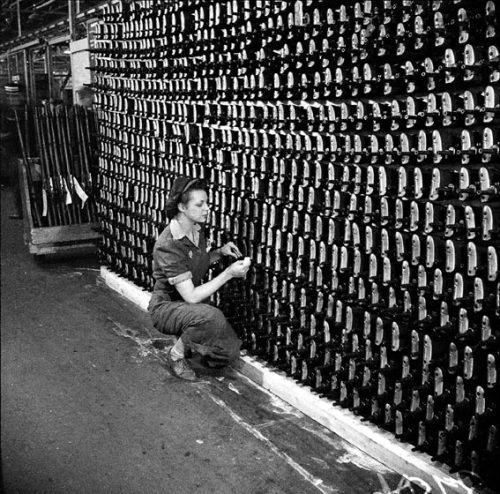
In Toronto, all efforts during the war were directed towards the production of military equipment. Many businesses quickly retooled to supply the front lines with necessary machinery and military supplies. With a shortage of manpower, women were increasingly brought into these roles. Toronto women took on new responsibilities, producing munitions, shells, and similar items. For instance, a plant in Toronto’s Scarborough district, known as “Project-24,” was one of the most significant wartime facilities. This enterprise spanned over 346 acres and comprised 172 buildings. Here, women aged 17 to 70 worked with heavy machinery, handled explosives, and filled shells. The plant operated around the clock, with no right to stop. These women ensured the production of over 256 million munitions.
It’s worth noting that after the war, the plant was repurposed into residential housing, leading to the development of a new Toronto neighbourhood.
A large number of women also worked in the automotive industry in the Ontario region. They were involved in manufacturing military vehicles, including trucks and armoured vehicles. Similar plants operated in cities like Oshawa and Windsor.
Furthermore, Canada was one of the largest suppliers of aluminum and nickel during World War II. Consequently, Ontario’s metallurgical plants operated at full capacity, supplying the military with these crucial metals, and women actively worked in this sector as well.
While other cities and countries faced decline during the war, Toronto emerged as one of Canada’s largest industrial hubs. There was no shortage of work, and women played an active role in building the economy of the city and the country.
Statistically, at the peak of the war in 1943-1944, 439,000 women in Toronto were employed in the service sector, 373,000 in manufacturing, and 4,000 in construction.
Beyond the Factories: On the Home Front and the War Front
The women of Toronto didn’t just work in military plants. Their efforts were needed everywhere: in textile factories, agriculture, and the service sector.
Volunteer work in Toronto also largely fell on women’s shoulders. They organized various charitable events and sewed clothing for soldiers. Women initiated the creation of “Victory Gardens,” supplying soldiers with fresh produce.
Women’s volunteer efforts in Toronto also included knitting socks, scarves, and mittens. Parcels were systematically prepared for Canadians overseas. Women played a significant role in aiding refugees fleeing the war. In Toronto, these individuals were provided not only with clothing but also with access to refugee centres.
An interesting fact: during World War II, much of Canada’s silk and nylon was diverted for military needs. It reached a point where women in Toronto couldn’t find seamed stockings, which were highly popular at the time. Consequently, some women would draw lines on the back of their legs to mimic the look of stockings.
However, women in our city didn’t just work hard in local industries. Many aspired to defend their homeland with arms. This led to the decision to create women’s military organizations. Some Toronto women also enlisted. Over 50,000 Canadian women served in the armed forces during World War II. Notably, the Canadian Women’s Army Corps (CWAC) comprised 21,600 members, the Royal Canadian Air Force Women’s Division (WDs) had 17,400 members, and the Women’s Royal Canadian Naval Service (Wrens) accounted for 7,100 members. Overall, women held many positions in the military, including mechanics, fitters, and communication operators.
The Role of Women During the War
It must be emphasized that the role of women during World War II was colossal. Truthfully, there is very little information readily available about their heroism. However, before the war, women were generally not permitted to work in factories or on farms. So-called “men’s professions” existed, and it was widely believed that women could not master them. Yet, the war made it unequivocally clear that women could meet these challenges, as they demonstrated their strength and endurance in virtually every sphere of Toronto life.
Incidentally, after World War II ended, Toronto’s labour market began to change significantly. Many women continued to pursue various professions and advance their careers, although some returned to their traditional domestic roles.
Such was the life of women in Toronto during World War II. We hope you found this material informative and learned more about your city.

Створити аудіопереказ